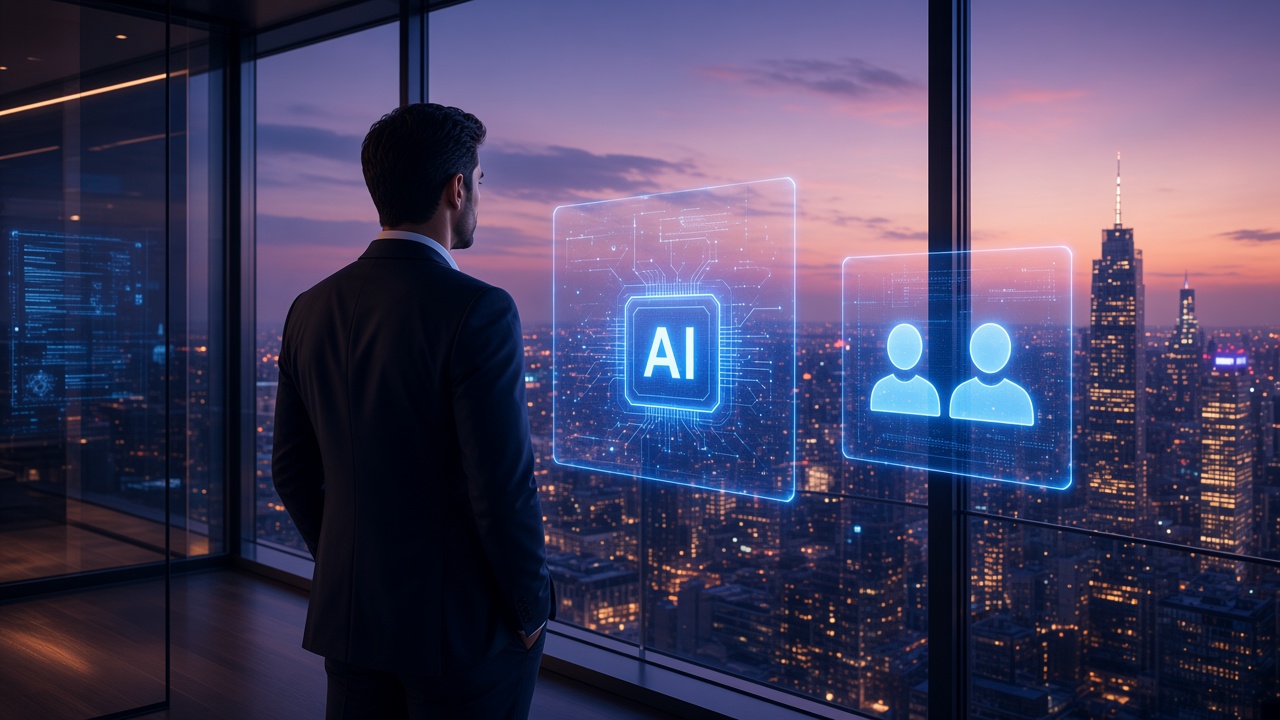
AI is changing how we work, learn and live. The real opportunity is not to replace people, but to help them achieve more. Are we ready to embrace this change?
Artificial Intelligence is changing the way the world works. Yet, much of the conversation around AI is dominated by one question:
Will AI replace humans?
Perhaps we should be asking a different question:
What can humans achieve when they learn to work with AI?
AI is no longer just a technology for developers, researchers or large technology companies. It is becoming part of everyday life, influencing how teachers teach, employees work, businesses operate, students learn and individuals manage their daily activities.
The real opportunity is not to replace people. It is to empower people to achieve more.
We have seen this transformation before
Consider the introduction of computers into workplaces.
There was a time when computerisation was met with considerable resistance. In many places, including government offices, employees raised concerns about changing working practices, job security and the introduction of computers. Strikes and protests were part of this transition in some workplaces.
Today, computers are fundamental to almost every organisation.
Government departments process applications digitally. Employees manage information through software. Schools use digital learning platforms. Businesses depend on technology to manage their operations.
Computers did not make everyone a programmer. They changed how people performed their jobs.
The internet, smartphones and cloud computing followed similar paths. Every major technological shift created uncertainty, required people to learn new skills and eventually became part of everyday life.
AI represents another major transformation.
The difference is that computers helped us process and manage information, while AI can also help us understand, analyse, create, reason and solve problems.
Does AI make people lazy?
This is a concern worth discussing.
When technology takes over repetitive work, does that mean people become less productive or less capable?
Not necessarily.
Think about an employee who spends several hours preparing reports, responding to emails, organising information and performing repetitive administrative tasks.
With AI, many of these activities can be completed much faster.
Does that mean the employee should simply do less?
Not at all.
It creates an opportunity to focus on more meaningful work, improve other areas of responsibility, solve additional problems and contribute more to the organisation.
The same applies to personal life.
Imagine having more time to learn something new, manage personal responsibilities, plan family activities, explore a business idea or spend quality time with family.
AI can reduce the time spent on repetitive activities and create more room for the things that matter.
The purpose of AI should not be to make people work less meaningfully. It should help people accomplish more with the time they have.
Of course, blindly accepting AI-generated answers or allowing technology to make every decision is not the objective. Human judgment, critical thinking and responsibility remain essential.
The goal is not to become dependent on AI. It is to become more capable by using it.
Is 24 hours still enough?
There was a time when people often said, "24 hours a day is not enough to get everything done."
Today, with AI, imagine what becomes possible when we learn to use it properly.
It can feel like having 10 times the productive capacity within the same 24 hours. Not because the day has become longer, but because we can research faster, create faster, analyse faster, learn faster and accomplish tasks that previously required considerably more time and effort.
The modern world is already moving fast. AI is accelerating that pace even further.
The question is no longer how many hours we have in a day. It is how effectively we use the time and capabilities available to us.
AI doesn't give us more hours. It gives us the opportunity to achieve much more within the hours we already have.
You have an Einstein at your fingertips. Use it.
Think about it for a moment.
Through a device in your hand, you now have access to an extraordinary level of knowledge, reasoning and problem-solving capability.
You can ask questions, understand complex subjects, explore business opportunities, write, calculate, research, create, learn new skills and develop ideas.
It is almost like having an Einstein at your fingertips.
And it is not a small thing.
A person without a technical background can explore subjects that previously required specialist assistance. A small business owner can analyse information that might once have required an entire team. A teacher can explore different ways of explaining a difficult concept. An employee can find ways to simplify everyday responsibilities.
The opportunity is enormous.
But having access to such a powerful tool is only the beginning.
You need to use it, experiment with it, challenge its answers and understand its limitations.
Don't just carry that intelligence in your pocket. Put it to work.
AI is for everyone, not just technology professionals
You don't need to be a programmer, data scientist or technology specialist to benefit from AI.
Teachers and educators
Teachers can use AI to prepare lesson plans, generate learning materials, develop assessments, analyse student progress and explore different teaching approaches. This can reduce preparation time and create more opportunities to focus on individual students.
Employees and professionals
Employees can use AI to prepare reports, organise information, summarise documents, manage communication, analyse data and simplify repetitive activities. They can spend more time on problem-solving, collaboration and improving their work.
Business owners and entrepreneurs
Small and medium-sized businesses can use AI to understand customers, explore new business ideas, prepare marketing campaigns, analyse performance and improve customer service without necessarily requiring large teams.
Government and public services
AI can assist with document processing, application classification, information retrieval, service enquiries and administrative workflows. This can help public-sector employees spend more time on complex cases and citizen services.
Individuals and families
AI can support everyday learning, personal planning, organising activities, understanding unfamiliar topics, exploring interests and managing daily responsibilities.
The opportunities are not limited to a particular profession, industry or organisation size.
The biggest opportunity: reducing dependency and removing barriers
One of the most exciting aspects of AI is its ability to reduce the distance between having an idea and making it happen.
Previously, a business owner might need to approach several specialists to explore a new business concept.
A teacher might need technical assistance to develop a digital learning resource.
An employee might have an excellent idea for improving an internal process but lack the technical skills to implement it.
AI can help bridge these gaps.
People can now research, plan, create, experiment, develop prototypes and explore solutions with assistance from AI.
This does not mean that professional expertise, collaboration or human knowledge are no longer important. Rather, people can take greater initiative and make better use of the resources available to them.
Ideas should not remain unexplored simply because someone lacks the resources, budget or technical knowledge to take the first step.
Who should be concerned?
Perhaps the real concern should not be about AI becoming more capable.
It should be about whether people and organisations are prepared to adapt.
Technology will continue to evolve, regardless of whether everyone is comfortable with it.
People who are willing to learn, experiment and integrate new tools into their work will discover new ways to create value.
On the other hand, individuals and organisations that completely resist change may find it increasingly difficult to remain competitive and relevant.
This is not about age, qualifications or professional background. It is about mindset.
A teacher does not need to become an AI engineer. An accountant does not need to become a software developer. A business owner does not need to understand the technical architecture of an AI model.
They need to understand where AI can help, how to use it responsibly and when human judgment is essential.
Organisations also have a responsibility to support their employees through this transition by providing the right tools, training and opportunities to learn.
Nobody should be expected to understand everything about AI overnight.
But everyone should be willing to start learning.
Adaptability is the skill of the future
Just as computer literacy became an essential workplace skill, understanding how to work with AI is becoming increasingly important.
The transition does not have to happen overnight.
Start with one task. Identify one challenge. Explore one opportunity. Try using AI to solve a problem you face every day.
Don't wait until everyone around you has adopted it. Don't wait until your organisation makes it mandatory. Start exploring the possibilities today.
The future is not simply about AI replacing human capabilities. It is about combining human experience, creativity and judgment with new technological possibilities.
AI is not here to replace you. But are you ready to adapt?
Don't fear the change. Understand it. Embrace it. Adapt to it.
You have an Einstein at your fingertips. Don't be afraid of it. Learn to use it.
Skien Software Lab, Trivandrum and Calicut. Tell us the problem you want to look at first.
 AI Is Moving Fast. But Are We Ready to Trust It?
 AI Is Not Just for Big Companies. It Is an Opportunity for Every Business.